Sunday within the Octave of Corpus Christi — From Dom Guéranger’s Liturgical Year
Liturgy of the Hours
6.6.26 Vespers I, Saturday Evening Catholic Prayer of the Liturgy of the Hours
- 6.7.26 Lauds, Sunday Morning Catholic Prayer of the Liturgy of the Hours
ORDINARY ROMAN CALENDAR
– Keith Nester – Unpacking The Mass – The Solemnity of the Most Holy Body and Blood of Christ – Year A
https://en.peripsum.org/AM/gospel/2026-06-07
Readings
-Daily Reading for Sunday, June 7th, 2026 HD
https://www.youtube.com/watch?v=5vwBoUe6P10
Reflection
– Questions for Reflection for June 7, 2026 HD
Book of Deuteronomy 8,2-3.14b-16a.
Moses said to the people:
“Remember how for forty years now the LORD, your God, has directed all your journeying in the desert, so as to test you by affliction and find out whether or not it was your intention to keep his commandments. He therefore let you be afflicted with hunger, and then fed you with manna, a food unknown to you and your fathers, in order to show you that not by bread alone does man live, but by every word that comes forth from the mouth of the LORD. “Do not forget the LORD, your God, who brought you out of the land of Egypt, that place of slavery; who guided you through the vast and terrible desert with its saraph serpents and scorpions, its parched and waterless ground; who brought forth water for you from the flinty rock
and fed you in the desert with manna, a food unknown to your fathers.”
Psalms 147,12-13.14-15.19-20.
Glorify the LORD, O Jerusalem;
praise your God, O Zion.
For he has strengthened the bars of your gates;
he has blessed your children within you.
He has granted peace in your borders;
with the best of wheat he fills you.
He sends forth his command to the earth;
swiftly runs his word!
He has proclaimed his word to Jacob,
his statutes and his ordinances to Israel.
He has not done thus for any other nation;
his ordinances he has not made known to them. Alleluia
First Letter to the Corinthians 10,16-17.
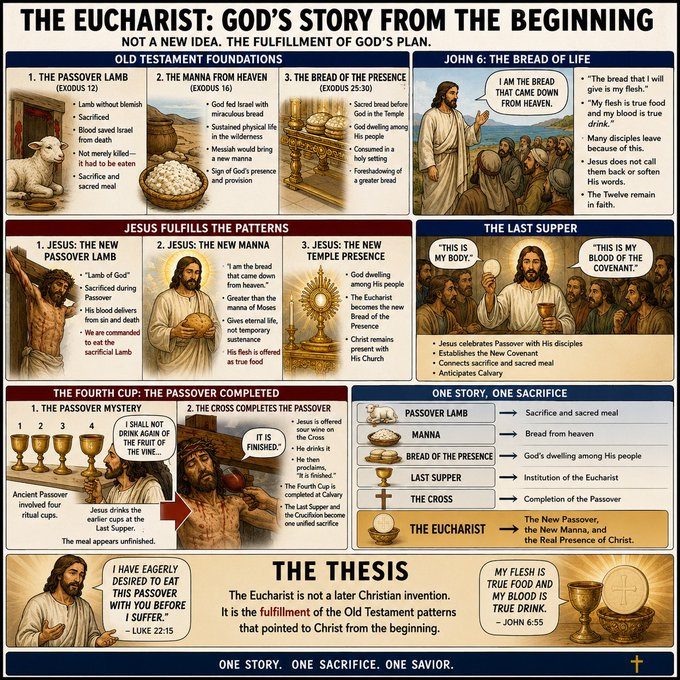
Brothers and sisters: The cup of blessing that we bless, is it not a participation in the blood of Christ? The bread that we break, is it not a participation in the body of Christ? Because the loaf of bread is one, we, though many, are one body, for we all partake of the one loaf.
Holy Gospel of Jesus Christ according to Saint John 6,51-58.
Jesus said to the crowds: “I am the living bread that came down from heaven; whoever eats this bread will live forever; and the bread that I will give is my flesh for the life of the world.” The Jews quarreled among themselves, saying, “How can this man give us (his) flesh to eat?” Jesus said to them, “Amen, amen, I say to you, unless you eat the flesh of the Son of Man and drink his blood, you do not have life within you. Whoever eats my flesh and drinks my blood has eternal life, and I will raise him on the last day. For my flesh is true food, and my blood is true drink. Whoever eats my flesh and drinks my blood remains in me and I in him. Just as the living Father sent me and I have life because of the Father, so also the one who feeds on me will have life because of me. This is the bread that came down from heaven. Unlike your ancestors who ate and still died, whoever eats this bread will live forever.”
Copyright © Confraternity of Christian Doctrine, USCCB
Saint John-Mary Vianney (1786-1859)
priest, curé of Ars – Sermon for the 6th Sunday of Easter
The happiness we have in receiving Jesus Christ
Who among us, could ever have understood that Jesus Christ would have carried his love towards his creatures to the point of giving them his adorable Body and his precious Blood to serve as food for our souls, if it was not He himself who told us so? What! Friends, a soul feeds on its Savior!… and this as many times as it desires!… O abyss of goodness and love of a God for his creatures!… Saint Paul tells us, that the Savior, by taking on our flesh, hid his divinity and brought humiliation to the point of annihilation. But, by instituting the adorable sacrament of the Eucharist, he veiled his very humanity, he only revealed the depths of his mercy. See what the love of a God for his creatures is capable of!… No, friends, of all the sacraments, there is none that can be compared to that of the Eucharist. (…) Saint John tells us that Jesus Christ “having loved men to the end” (Jn 13:1), found the way to ascend to heaven without leaving earth: he took bread in his holy and venerable hands, blessed it and changed it into his Body; he took wine and changed it into his precious Blood, and gave to all the priests, in the person of his apostles, the power to perform the same miracle, whenever they pronounced the same words; so that, through this miracle of love, he could stay with us, serve us as food, comfort us and keep us company. (…) Oh ! what happiness for a Christian to aspire to such a great honor as to feed on the bread of angels!…If we understood the greatness of the happiness we have in receiving Jesus Christ, would we not continually work to deserve it?
1962 Missal
Readings & Reflection
https://en.peripsum.org/TRA/gospel/2026-06-07
First Epistle of Saint John 3,13-18.
Wonder not, brethren, if the world hate you.
We know that we have passed from death to life, because we love the brethren. He that loveth not abideth in death. Whosoever hateth his brother is a murderer. And you know that no murderer hath eternal life abiding in himself. In this we have known the charity of God, because he hath laid down his life for us: and we ought to lay down our lives for the brethren. He that hath the substance of this world and shall see his brother in need and shall shut up his bowels from him: how doth the charity of God abide in him? My little children, let us not love in word nor in tongue, but in deed and in truth.
Holy Gospel according to Saint Luke 14,16-24.
But he said to him: A certain man made a great supper and invited many. And he sent his servant at the hour of supper to say to them that were invited, that they should come: for now all things are ready.
And they began all at once to make excuse. The first said to him: I have bought a farm and I must needs go out and see it. I pray thee, hold me excused.
And another said: I have bought five yoke of oxen and I go to try them. I pray thee, hold me excused.
And another said: I have married a wife; and therefore I cannot come. And the servant returning, told these things to his lord. Then the master of the house, being angry, said to his servant: Go out quickly into the streets and lanes of the city; and bring in hither the poor and the feeble and the blind and the lame. And the servant said: Lord, it is done as thou hast commanded; and yet there is room.
And the Lord said to the servant: Go out into the highways and hedges, and compel them to come in, that my house may be filled. But I say unto you that none of those men that were invited shall taste of my supper.
Baldwin of Ford (?-c.1190) – Cistercian abbot, then Bishop
The Sacrament of the altar, II, 3 ; PL 204, 691
“Blessed are those who dine in the kingdom of God.”
The psalmist says: “Bread fortifies the heart of man and wine rejoices his heart” (Ps 104[103]:15). For those who believe in him Christ is food and drink, bread and wine. He is bread when he strengthens and establishes us according to Peter’s words: “After you have suffered a little, the God of all grace who called you to his eternal glory in Christ will restore, strengthen and establish you” (1Pt 5:10). He is drink and wine when he makes us glad according to the words of the Psalmist: “Gladden the soul of your servant, for to you, O Lord, I lift up my soul” (Ps 86[85]:4).
Everything in us that is strong, steadfast, firm, happy and joyful to carry out God’s commands, bear with misfortune, act obediently, stand up for justice: all these things come from this bread’s strength, this wine’s gladness. Happy are they whose deeds are strong and joyful! And since no one can do it of themselves: happy are they who have an eager desire to cleave to what is just and right and to be strengthened in everything and rejoice through him who said: “Blessed are they who hunger and thirst for righteousness” (Mt 5:6). If Christ is food and drink even now for the strength and joy of the righteous, how much more so will he be in the life to come when he will give to the righteous without measure?
Saint of the Day
ST. ROBERT OF NEWMINSTER
(12th century)
In 1132 Robert was a monk at Whitby, England, when news arrived that thirteen religious had been violently expelled from the Abbey of St. Mary, in York, for having proposed to restore the strict Benedictine rule. He at once set out to join them, and found them on the banks of the Skeld, near Ripon, living in the midst of winter in a hut made of hurdles and roofed with turf. In the spring they affiliated themselves to St. Bernard’s reform at Clairvaux, and for two years struggled on in extreme poverty. At length the fame of their sanctity brought another novice, Hugh, Dean of York, who endowed the community with all his wealth, and thus laid the foundation of Fountains Abbey. In 1137 Raynulph, Baron of Morpeth, was so edified by the example of the monks at Fountains that he built them a monastery in Northumberland, called Newminster, of which St. Robert became abbot.
The holiness of his life, even more than his words, guided his brethren to perfection, and within the next ten years three new communities went forth from this one house to become centres of holiness in other parts. The abstinence of St. Robert in refectory alone sufficed to maintain the mortified spirit of the community. One Easter Day, his stomach, weakened by the fast of Lent, could take no food, and he at last consented to try to eat some bread sweetened with honey. Before it was brought, he felt this relaxation would be a dangerous example for his subjects, and sent the food untouched to the poor at the gate. The plate was received by a young man of shining countenance, who straightway disappeared. At the next meal the plate descended empty, and by itself, to the abbot’s place in the refectory, proving that what the Saint sacrificed for his brethren had been accepted by Christ.
At the moment of Robert’s death, in 1159, St. Godric, the hermit of Finchale, saw his soul, like a globe of fire, borne up by the angels in a pathway of light; and as the gates of heaven opened before them, a voice repeated twice, “Enter now, my friends.”
Lives of the Saints, by Alban Butler, Benziger Bros. ed. [1894]