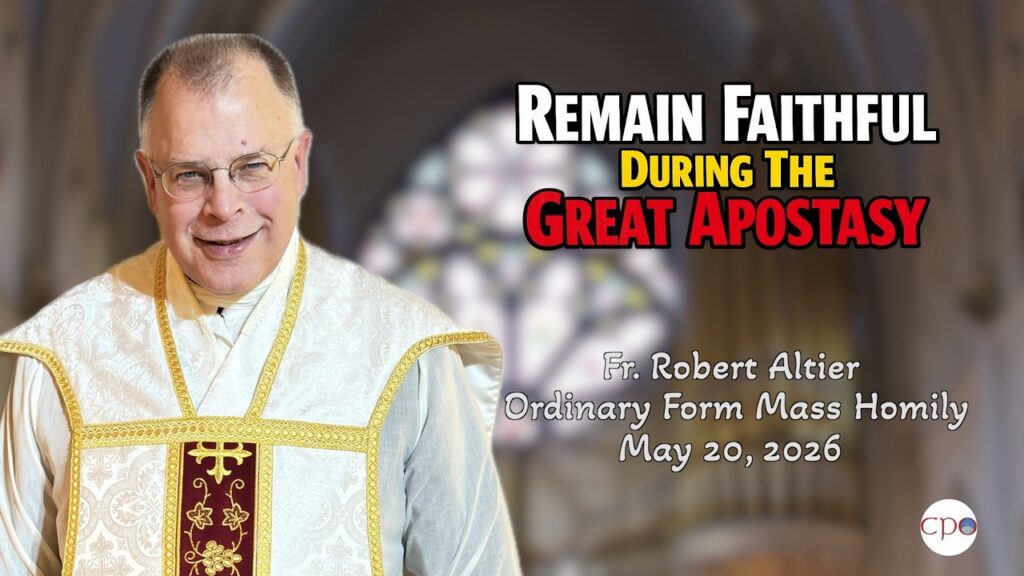
Can someone reject the Church, ignore apostolic tradition, refuse Christian accountability, and still claim that “just me and my Bible” is enough?
In this powerful discussion, a Catholic convert asks how to answer a non-denominational friend who rejects the oral traditions commanded in 2 Thessalonians 2:15, belongs to no church, refuses to work, and treats biblical correction as a personal attack.
The conversation exposes the danger of creating a private Christianity with no Church, no authority, no discipline, and no obligation to obey.
Scripture never teaches “just me and my Bible.” Jesus established a visible Church, gave His apostles authority, and commanded believers to listen to the Church. Paul commanded Christians to hold firmly to apostolic teaching transmitted both by word of mouth and by letter.
This discussion also answers:
• Can a Christian refuse to work and remain in good standing?
• Are believers required to belong to a church?
• When should an unrepentant person be removed from fellowship?
• Can someone lose salvation through persistent rebellion?
• Does faith without obedience save?
• What happens to branches in Christ that refuse to bear fruit?
• Is “faith alone” biblical when it produces no repentance or obedience?
Jesus warns that not everyone who calls Him “Lord” will enter the kingdom. The person who hears His words but refuses to obey is building on sand. A branch that refuses to remain in Christ is cut off and thrown into the fire.
Christianity is not “just me and my Bible.” It is Christ, His Church, His apostolic teaching, His sacraments, His commandments, and a life of faithful obedience.
Where does the Bible teach that every Christian can separate himself from the Church and become his own final authority?
Biblical References
Apostolic tradition and Church authority
2 Thessalonians 2:15 — Christians must hold firmly to traditions received orally and by letter.
1 Corinthians 11:2 — Paul praises believers for maintaining the traditions he delivered.
1 Timothy 3:15 — The Church is the household of God and the pillar and foundation of truth.
Matthew 18:15–18 — Jesus commands believers to bring unresolved disputes to the Church.
Luke 10:16 — Those who hear Christ’s authorized messengers hear Christ.
Acts 2:42 — The earliest Christians devoted themselves to apostolic teaching and fellowship.
Hebrews 10:24–25 — Christians must not abandon assembling together.
Work, responsibility, and idleness
1 Thessalonians 4:11–12 — Believers are commanded to work and avoid unnecessary dependence on others.
1 Thessalonians 5:14 — Christians must admonish the idle.
2 Thessalonians 3:6–15 — Anyone unwilling to work should not eat; persistent idleness requires discipline.
1 Timothy 5:8 — Refusing to provide for one’s household is a denial of the faith.
Correction and Church discipline
Matthew 18:15–17 — Christ establishes a process of correction culminating in the authority of the Church.
1 Corinthians 5:1–5 — The immoral man is removed from fellowship for the sake of repentance and salvation.
1 Corinthians 5:11–13 — Christians must not maintain ordinary fellowship with someone who claims Christ while persisting in grave sin.
Titus 3:10–11 — A divisive person should be warned and then avoided.
Luke 17:3–4 — Sin must be rebuked, and genuine repentance must be forgiven.
Obedience, perseverance, and salvation
Matthew 7:21–27 — Calling Jesus “Lord” is insufficient without doing the Father’s will.
John 14:21–24 — Those who love Christ keep His commandments.
John 15:1–10 — Branches in Christ must remain in Him and bear fruit or be cut off and burned.
James 2:14–26 — Faith without works is dead.
Romans 2:6–8, 13 — God judges according to deeds, and the doers will be justified.
Romans 11:20–22 — Believers must continue in God’s kindness or risk being cut off.
Colossians 1:22–23 — Believers must continue firmly established in the faith.
Philippians 2:12–13 — Christians must work out their salvation because God works within them.
Galatians 5:6 — Saving faith works through love.